Supercompensation and Timing of Training Effects

A few days back, I had a marathon weekend racing Duathlon Nationals and Seafair.  The next day (Monday), I was curled up in a fetal position on the couch and occasionally making cow-like sounds (memo to self: take such days as vacation or sick days).  I felt only slightly better on Tuesday.  A moderately hard (but failed) workout on Wednesday and an easy day on Thursday… maybe finally I’m ready to hit a hard workout.  And so that workout would be 2 x 30min at FTP or higher with 5min recovery.  I rode this one with my friend Mary.  Time escaped us and I was only able to get one effort in, but it was both comfortable and 10 watts higher than it should have been.  If I raced with this much energy on the weekend, I would have been unstoppable.  Obviously, at least for that day, anaerobic threshold (AT) was not my limiter.

So what’s going on here?  Simple, it’s just basic training effects and supercompensation.  According to Pete Pfitzinger, there are some basic rules to the timing of training effects. The bottom line is:

  • It takes 8-10 days to get benefits from any workout
  • It takes 8-10 days to recover from a maxVO2 workout
  • It takes 4 days to recover from lactate threshold and tempo workouts
  • Recovering from long runs takes the longest time
Continue reading

Why I Like to Do a Ton of Racing– And So Should You

Last year, I made it onto TeamUSA for ITU Long-Course World Duathlon Championships (Powerman Zofingen).  I trained all season really hard, averaging 40+ miles a week of running and 200+ miles a week of cycling.  I didn’t race more than a half dozen races.  I hated my life and I barely spent any time with my wife.  While my endurance was fantastic, my speed sucked.  Then, three days before the race, I severely strained my right soleus while jogging the running course of the race and my season was over.

After the race, I spent a lot of time looking back over my race history and I remembered that I tended to be happiest when I raced a lot.  My all-time record was racing in 23 races in one season.  While almost all of these races were lower-priority “B” or “C” races, they all still brought a greater sense of satisfaction to my athletic season than my one or two “A” races.  And, as Zofingen had proven to me, putting all of my eggs in one basket puts my overall happiness in a very precarious position.

Continue reading

Hit an FTP Plateau? Low-Cadence Hill Work Might be the Ticket

For years, my FTP was stuck at 225 watts.  No matter how hard I trained, I could never get it any higher.  I would go out for long 2-3 hour hard rides at 85-90% FTP every weekend.  I would hit the Computrainer every week and do the classic 2 x 20min at 100% FTP on five minutes recovery.  Nada.  In reality, my FTP was probably quite a bit higher because I suck at 20 minute all-out indoor FTP tests.  But even if it was higher,  the power that I could bring to these hard workouts wasn’t going up.  Sure, my body was adapting and I wasn’t getting devastated by them nearly as much after each workout, but the raw power was pretty level.

Continue reading

Hate Your PT Routine? Record It and Just Do It!

If you’re into any endurance sport, you probably have seen a physical therapist more times than you care to remember.  A good PT is a magician in fixing your body but sometimes the elaborate routines of exercises that they assign can be a little daunting.  Some people are fine with reading the exercises off a sheet of paper, remembering all the cues that their PT warned them about for each exercise, and then mechanically going through the steps to make it happen.  I wouldn’t be one of those people.  Combine a highly perceptible degree of boredom with a virtually imperceptible degree of confusion/stress from having to figure out the exercise and, well, the exercise just doesn’t get done. Eliminate the second part (confusion/stress) and doing an exercise routine seems so much easier.  I think this is one of the reasons why exercise videos and classes have so much better consistency than just trying to do an exercise program out of a book.

Continue reading

Starting Off with a Bang: Duathlon Nationals 2014 and Seafair

I’m a bit of a nut when it comes to my training and racing, but this weekend was extreme even by my standards.  I hadn’t thought about the folks reading my blog when I started on my Odyssey, so I don’t have many photos to share from the experience.  In short, it was three days, two 1,500 mile plane trips, and two hard races all compressed into one very busy weekend.  Despite plantar fasciitis interfering with my race schedule, these were still races 12 and 13 of the year me– but I still have a long way to go before I can come close to my record of 23 races in one season.

Duathlon Nationals 2014 (St. Paul, MN)

The Odyssey started at 4:45am last Friday, when my friend Mary Craig picked me up and we drove to the Seattle-Tacoma Airport for an early morning flight to Minneapolis-St. Paul.  We arrived in the early afternoon, quickly drove the race course (which had been changed because much of the course had been flooded) and then built our bikes and prepped for the race on Saturday.

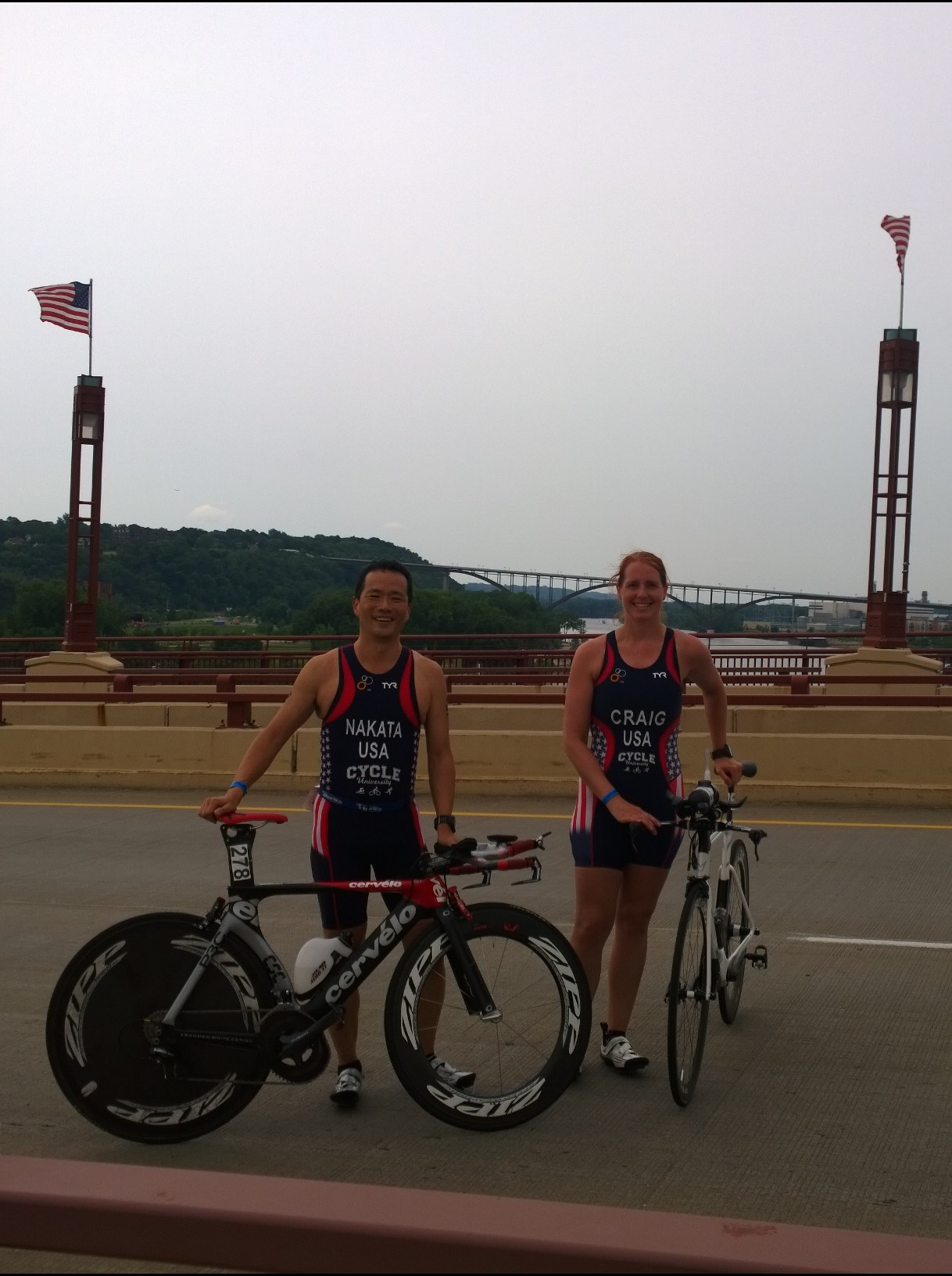
Mary and me after Duathlon National but before gelatoMorning came early with a 5:00am alarm (3:00am home time) and then off to the transition zone to set up the bike for the race start.  By 8:00am, my race was underway.  First run was slow– I’ve been fighting plantar fasciitis all summer so my running speed isn’t nearly as fast as it was in the winter and early spring.  Bike was awesome.  The second run was just a touch slower than the first run, but I was consistent with my competitors who all ran the first leg far too fast.  I crossed the line in 170th place out of 349 competitors.  My age group is a bit more competitive as I was about two-thirds the way down at 20th place out of 30 competitors.  While I’m used to winning my age group back in Seattle, I have to keep telling myself that Nationals are the big leagues.

Continue reading